Best Refinance Rates in Singapore

Head of Research
|
Updated 29 Mar 2026
|

Fact-checked

Disclosure

Glossary

Useful Resources

Head of Research
Updated 29 Mar 2026
|

Fact-checked

Refinancing a home loan is one of the most effective ways to reduce monthly mortgage payments and save tens of thousands of dollars over the life of a loan. This page covers everything there is to know about refinancing in Singapore: how it differs from repricing, when refinancing makes financial sense, the costs & common fees, eligibility requirements including TDSR rules and a breakdown of the entire process. It also explains the key considerations for HDB flat owners switching from an HDB concessionary loan to a bank loan and how private property owners can access home equity through cash out refinancing.

Whether the goal is to secure a lower interest rate, switch from fixed to floating or restructure your loan tenure this page provides the information needed to make a more informed decision.

More Details

Refinancing is the process of replacing an existing home loan with a new one from a different bank. The new bank pays off the old loan and issues a new mortgage — typically with a lower interest rate, different loan structure, or better features. Refinancing is commonly done when lock-in periods end and homeowners want to take advantage of lower market rates. 

  • Existing homeowners with an outstanding mortgage
  • Lock-in period has ended or willing to pay penalty
  • Outstanding loan amount typically above $100,000
  • Must meet TDSR of below 55%) exemptions apply for owner occupied properties
  • Property valuation must support the loan amount
  • Minimum remaining lease requirements for HDB
icon Credit score affects approval and rate offered. Good repayment history improves chances.
  • Salaried Employees:
  • NRIC
  • Latest 3 months payslips
  • Latest 12 months CPF contribution history
  • Latest Notice of Assessment (NOA) from IRAS
  • Current loan statement showing outstanding balance
  • Title deed or property ownership documents
  • Self-Employed:
  • Latest 2 years NOA from IRAS
  • Latest 2 years audited financial statements
  • ACRA business profile
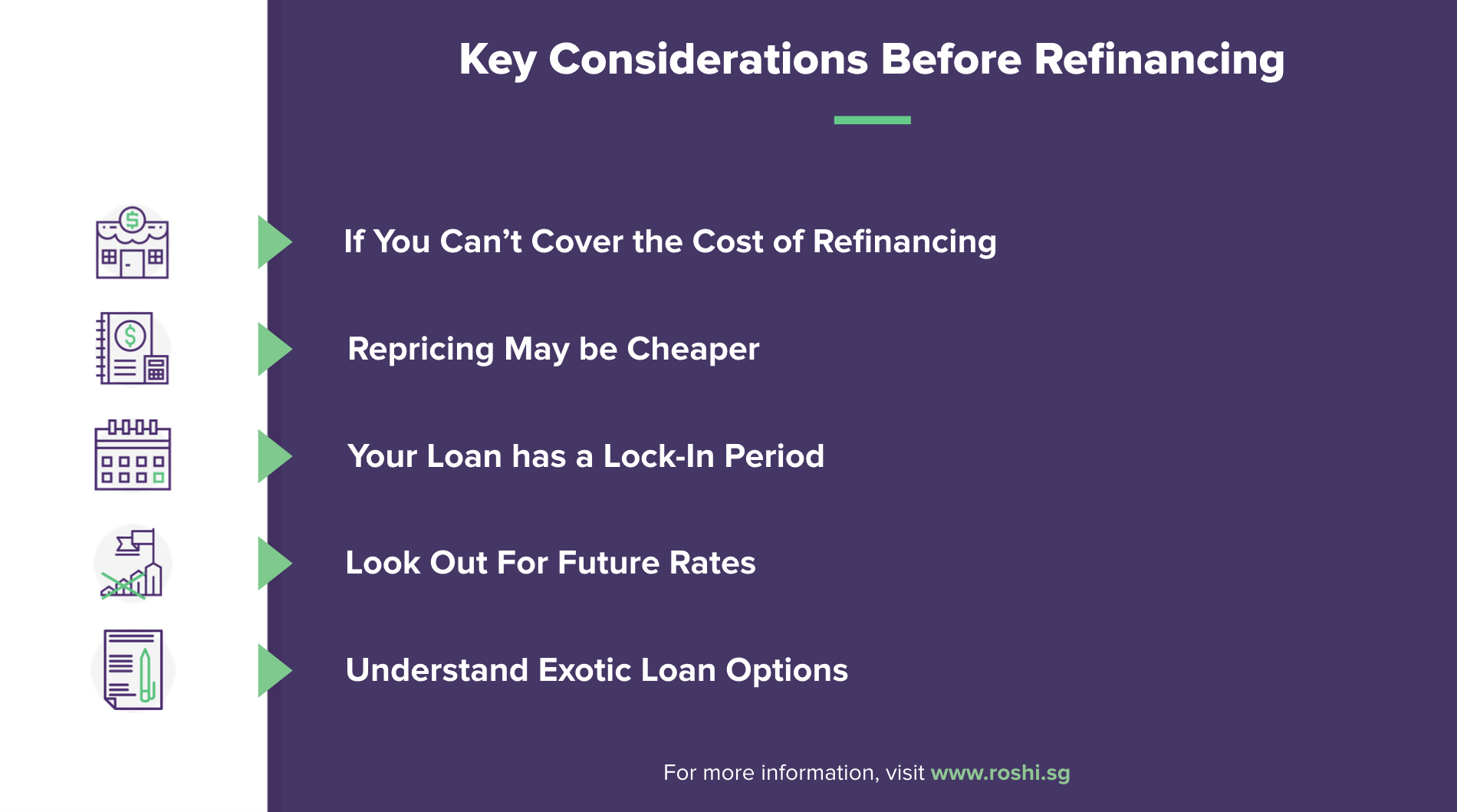
Start comparing rates 4 to 6 months before lock-in ends
Submit application to new bank 3 to 4 months before lock-in ends
Bank approval and valuation 2 to 4 weeks
Serve notice to existing bank 2 to 3 months (notice period)
Legal completion and loan transfer 2 to 4 weeks
Total process 3 to 4 months
icon Most banks require 2 to 3 months notice to the existing bank before the loan can be transferred

Disclosure

Glossary

Useful Resources

img
Current
Rates

Bank refinancing rates start from 1.50% p.a. (fixed) and SORA+0.25% (floating). HDB concessionary loan rate is 2.6%.

img
Potential
Savings

A 1% rate reduction on a $500,000 loan saves approximately $220 per month or $2,640 per year. Over 10 years, that's $26,400+.

img
Legal
Subsidy

Most banks offer $2,000 to $2,800 in legal fee subsidies for refinancing. Additional cashback may also be available.

img
Timing

Start comparing 4 to 6 months before lock-in ends. The refinancing process typically takes 3 to 4 months to complete.

What Property Are You Refinancing?

img
HDB Flat
bank loan to bank loan
Best for:
HDB owners with existing bank loans exiting lock-in. When lock-in ends, compare new rates across banks. Switch to a lower rate and save thousands. 
Key points:
Compare 15+ banks plus legal fees subsidised.
img
HDB Flat
hdb loan to bank loan
Best for:
HDB owners with concessionary loan (2.6%). Bank rates are currently lower than the HDB concessionary rate of 2.6%. Consider switching to save money but be aware that this move is irreversible. 
Key points:
Cannot switch back to HDB loan and need 5% cash for down payment top-up
img
Private Property
Condo • Landed
Best for:
Condo and landed property owners. Refinancing or cash-out refinancing options available. Compare rates and features from 15+ banks.
Key points:
Cash-out up to 75% LTV minus outstanding loan and CPF used.

Master All Your Refinance Moves

Choose a topic to learn more

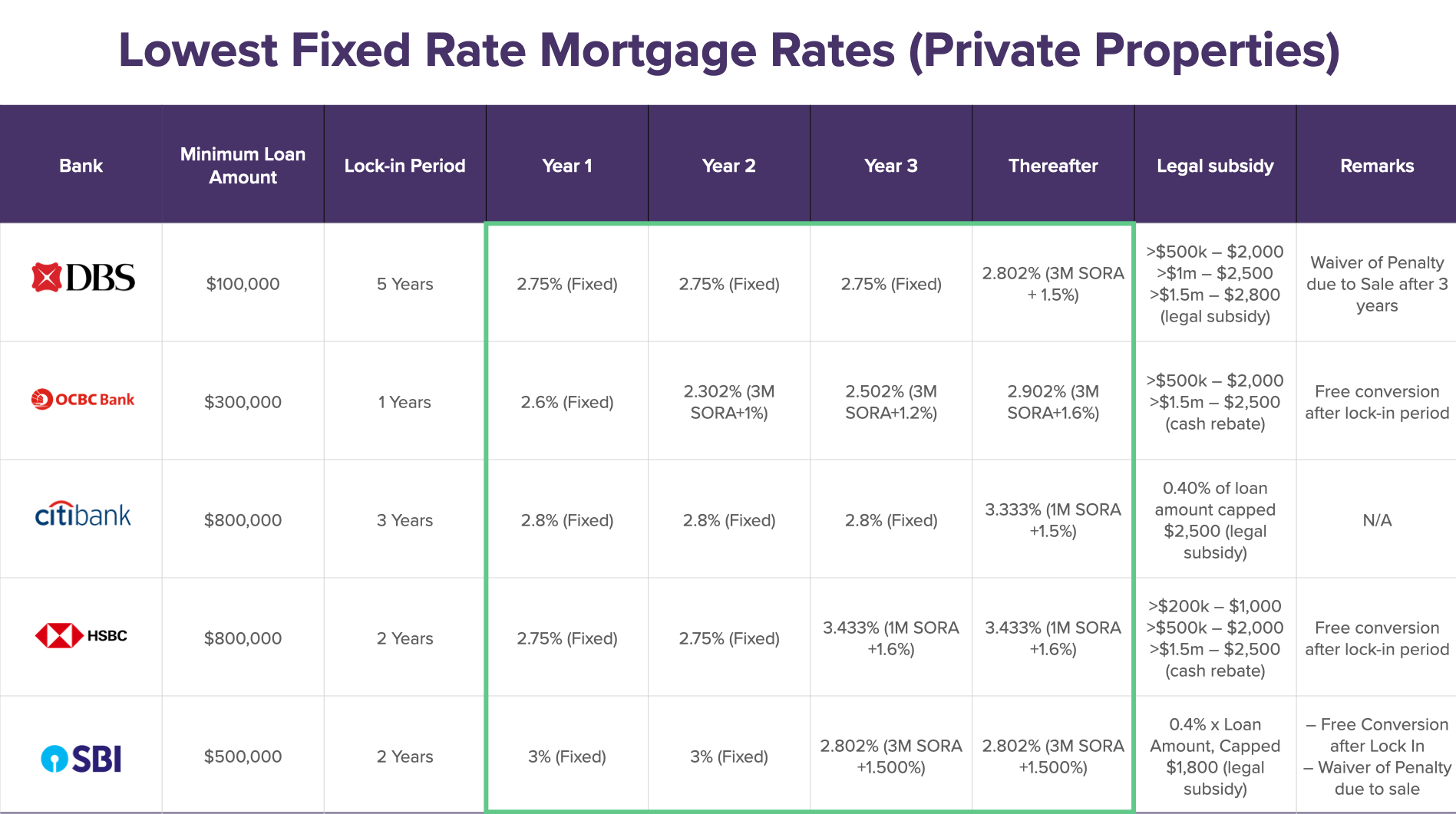
Compare The Latest Refinancing Rates

Bank Scheme Lock In Period 1st Yr Interest 2nd Yr Interest 3rd Yr Interest 4th Yr Interest
Standard Chartered 1-Month SORA 0 year 1.68% 1.68% 1.68% 1.68%
Standard Chartered 1-Month SORA 0 year 1.60% 1.65% 1.70% 1.90%
Standard Chartered 1-Month SORA 2 years 1.60% 1.65% 1.70% 1.90%
DBS 3-Month SORA 0 year 1.74% 1.74% 1.74% 1.74%
OCBC 1-Month SORA 2 years 1.60% 1.60% 1.80% 2.05%
Standard Chartered 1-Month SORA 0 year 1.65% 1.75% 1.75% 1.90%
Standard Chartered 1-Month SORA 2 years 1.65% 1.75% 1.75% 1.90%
DBS 3-Month SORA 0 year 1.77% 1.77% 1.77% 1.77%
Maybank 3-Month SORA 0 year 1.77% 1.77% 1.77% 1.77%
OCBC 1-Month SORA 2 years 1.65% 1.65% 1.80% 2.05%
Bank Scheme Lock In Period 1st Yr Interest 2nd Yr Interest 3rd Yr Interest 4th Yr Interest
Standard Chartered 1 Year Fixed 2 years 1.70% 1.60% 1.70% 1.85%
Standard Chartered 2 Year Fixed Flexi 2 years 1.65% 1.65% 1.70% 1.85%
Standard Chartered 2 Year Fixed Flexi 2 years 1.70% 1.70% 1.70% 1.85%
DBS 3 Year Fixed 3 years 1.65% 1.65% 1.65% 2.49%
DBS 3 Year Fixed Flexi 3 years 1.65% 1.65% 1.65% 2.49%
DBS 3 Year Fixed Flexi 3 years 1.68% 1.68% 1.68% 2.49%
DBS 3 Year Fixed 3 years 1.68% 1.68% 1.68% 2.49%
Standard Chartered 3 Year Fixed Flexi 3 years 1.75% 1.75% 1.75% 2.30%
RHB 1 Year Fixed 2 years 1.85% 1.80% 1.90% 2.00%
Standard Chartered 2 Year Fixed 2 years 2.00% 2.00% 1.70% 1.85%
Bank Scheme Lock In Period 1st Yr Interest 2nd Yr Interest 3rd Yr Interest 4th Yr Interest
HDB Concessionary Loan None 2.60% 2.60% 2.60% 2.60%
Bank Scheme Lock In Period 1st Yr Interest 2nd Yr Interest 3rd Yr Interest 4th Yr Interest
OCBC 1-Month SORA 0 year 1.55% 1.55% 1.55% 1.55%
OCBC 1-Month SORA 0 year 1.58% 1.58% 1.58% 1.58%
OCBC 1-Month SORA 0 year 1.60% 1.60% 1.60% 1.60%
RHB 1-Month SORA 0 year 1.68% 1.68% 1.68% 1.68%
OCBC 1-Month SORA 0 year 1.68% 1.68% 1.68% 1.68%
Standard Chartered 1-Month SORA 0 year 1.68% 1.68% 1.68% 1.68%
RHB 1-Month SORA 0 year 1.7% 1.70% 1.70% 1.70%
Standard Chartered 1-Month SORA 0 year 1.60% 1.65% 1.70% 1.90%
Standard Chartered 1-Month SORA 2 years 1.60% 1.65% 1.70% 1.90%
OCBC 3-Month SORA 0 year 1.74% 1.74% 1.74% 1.74%
Bank Scheme Lock In Period 1st Yr Interest 2nd Yr Interest 3rd Yr Interest 4th Yr Interest
Standard Chartered 1 Year Fixed 2 years 1.70% 1.60% 1.70% 1.85%
Standard Chartered 2 Year Fixed Flexi 2 years 1.65% 1.65% 1.70% 1.85%
Standard Chartered 2 Year Fixed Flexi 2 years 1.70% 1.70% 1.70% 1.85%
Bank of China 3 Year Fixed (Green Mortgage) 3 years 1.60% 1.60% 1.65% 2.49%
DBS 3 Year Fixed Flexi 3 years 1.65% 1.65% 1.65% 2.49%
Bank of China 3 Year Fixed 3 years 1.65% 1.65% 1.65% 2.49%
DBS 3 Year Fixed 3 years 1.65% 1.65% 1.65% 2.49%
DBS 3 Year Fixed 3 years 1.68% 1.68% 1.68% 2.49%
DBS 3 Year Fixed Flexi 3 years 1.68% 1.68% 1.68% 2.49%
Standard Chartered 3 Year Fixed Flexi 3 years 1.75% 1.75% 1.75% 2.30%
*All banks verified against the MAS registry. Last updated: March 3 2026.
img
  • 10+ banks compared
  • $2.5B+ mortgages facilitated
  • MAS verified lenders only

$1,000

$3,000,000

1%

10%

Refinancing vs Repricing

These terms are often confused but they represent very different approaches to optimising a home loan.
What Is Refinancing?
Refinancing means switching an existing home loan from one bank to a completely different bank. The new bank pays off the outstanding loan and issues a new mortgage with new terms, rates and conditions.
  • Switch to a different bank entirely
  • New loan agreement with new terms
  • Requires conveyancing and property valuation
  • Takes 3 to 4 months to complete
  • New lock-in period starts typically 2 to 3 years
  • Access to "acquisition rates" designed to attract new customers
  • Usually offers lower rates than repricing
What Is Repricing?
Repricing means switching to a different loan package within the same bank. The bank relationship stays the same but the interest rate structure changes.
  • Stay with the same bank
  • No legal work or valuation required
  • Takes about 1 month to complete
  • May have lower or no lock-in period
  • Administrative fee of $500 to $1,000
  • Limited to packages offered by current bank
  • "Retention rates" may be slightly higher than acquisition rates

Refinancing vs Repricing Comparison Table

Refinancing Repricing
DefinitionSwitch loan to a different bankSwitch package within same bank
Interest RatesAccess to "acquisition rates" typically lower"Retention rates" may be 0.1% to 0.3% higher
Timeline3 to 4 months1 month
Legal Work RequiredYesNo
Valuation RequiredYesNo
Costs$2,000 to $3,000 (often subsidised)$500 to $1,000 (admin fee)
Lock-In PeriodNew 2 to 3 year lock-inMay be shorter or none
Loan OptionsAccess to all banks' packagesLimited to current bank's packages
DocumentationFull application with income docsMinimal — internal bank process
Best ForLarger loans above $300k, maximising savingsSmaller loans below $300k, convenience
FlexibilityFull market accessLimited to one bank's offerings

When to Refinance vs Reprice

Refinancing
MAXIMUM SAVINGS
  • Choose this if:
  • icon Outstanding loan is above $300,000
  • icon Current bank's retention rates are not competitive
  • icon Wanting access to features current bank doesn't offer
  • icon Planning to stay in property for 3 plus more years
  • icon Comfortable with a longer process usually between 3 to 4 months
  • icon Willing to do paperwork for maximum savings
Repricing
QUICK & SIMPLE
  • Choose this if:
  • icon Outstanding loan is below $300,000
  • icon Current bank offers competitive rates
  • icon Preferring a quick and simple process
  • icon Wanting to avoid legal fees and valuation
  • icon Needing rate reduction within 1 month
  • icon Planning to sell property soon
Savings Comparison Example
Scenario: $700,000 outstanding loan, current rate 3.4%
OptionNew RateAnnual SavingsCostsNet Savings (3 years)
Refinancing2.7% (Bank B)$4,900$2,000 (subsidised)$12,700
Repricing3.0% (Same bank)$2,800$800$7,600
For larger loans refinancing typically offers significantly better savings despite higher upfront costs.
Our Expert says
Should You Switch Banks or Stay?
Trinh Thanh
Trinh Thanh
Head of Research

Banks typically offer lower "acquisition rates" to attract new customers and higher "retention rates" to keep existing ones. This pricing gap often 0.1% to 0.3% is sometimes called the "loyalty tax."

On a $1 million loan that difference can cost an extra $2,000 per year. For larger loans above $300,000 refinancing to a new bank almost always makes more financial sense than repricing with the current bank. For smaller loans below $200,000, the legal and valuation fees may outweigh the savings making repricing the more practical choice. The key is to calculate the total savings against total costs before deciding.

Switching from HDB Concessionary Loan to Bank Loan

A detailed guide for HDB flat owners considering this significant financial decision.
Why Consider Switching?
The HDB concessionary loan rate is fixed at 2.6% p.a. (pegged to CPF OA rate + 0.1%). As of 2026 bank loan rates have fallen significantly below this level starting from 1.50% p.a.
Potential savings
Savings Icon 1% rate difference on $400k = $3,600/yr savings
Savings Icon Over 10 years, this exceeds $36,000 in savings
Banks are reporting significant increases in HDB owners switching from HDB loans to bank loans; some banks have seen a 7x increase in such applications.
Warning Icon This decision is irreversible
Once an HDB loan is refinanced to a bank loan it is not possible to switch back to an HDB loan.

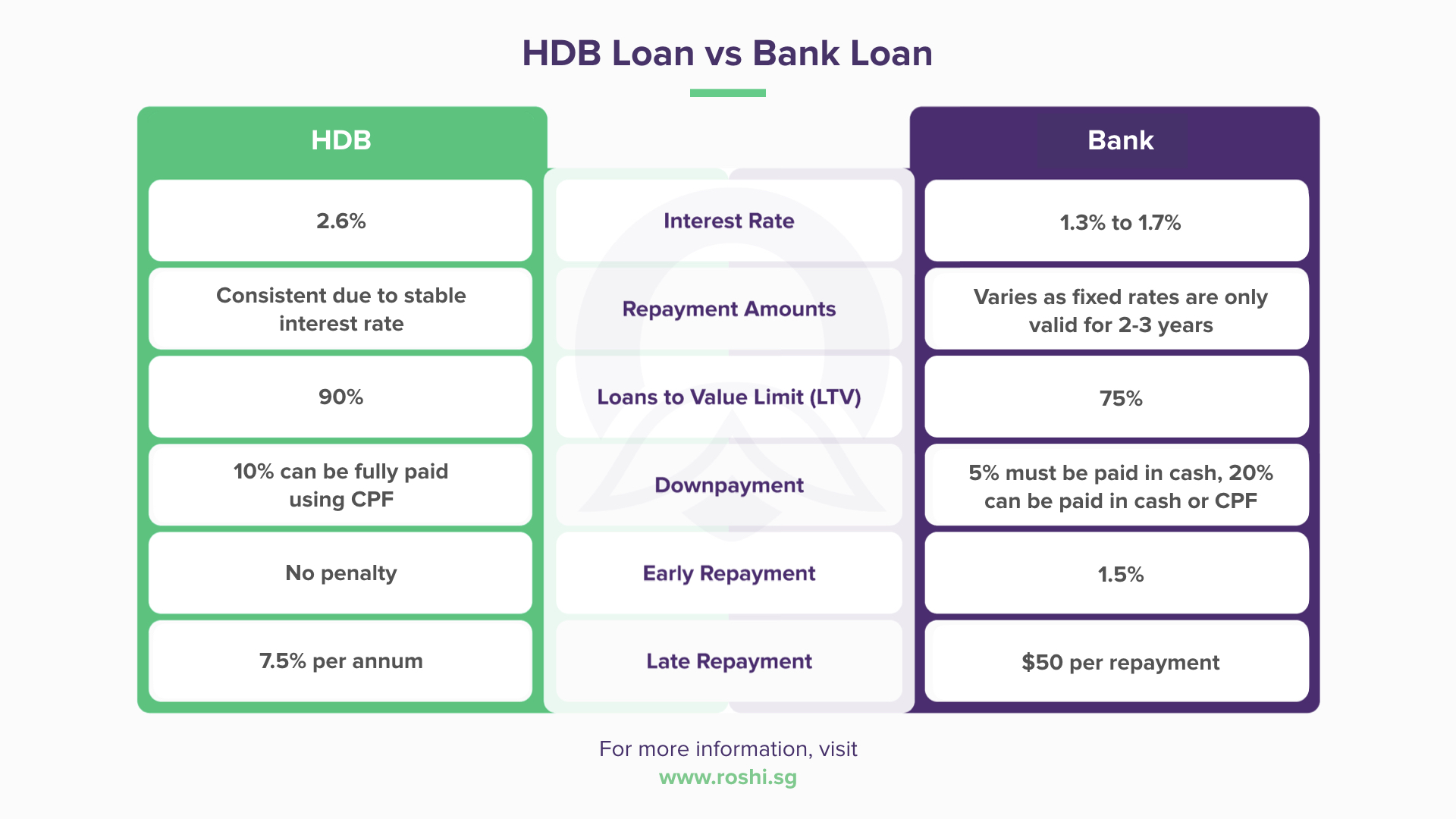
HDB Loan to Bank Loan Comparison

HDB Concessionary Loan Bank Loan (After Switch)
Interest Rate2.6% p.a. (fixed)From 1.50% p.a. (fixed) or SORA+0.25% (floating)
Rate StabilityExtremely stable (unchanged 20+ years)Fixed for 2 to 5 year then floating OR floating from start
LTV After SwitchN/AUp to 75%
Lock-In PeriodNone2 to 3 years
Early Repayment PenaltyNone1.5% during lock-in
Partial PrepaymentAllowed anytimeMay be limited during lock-in
Rate Fluctuation RiskNoneYes
Can Switch Back?N/AIrreversible
TDSR Applies?No (exempt)Owner-occupied: exempt for refinancing / Investment: applies
Cash Top-Up Requirement
When switching from HDB loan (80% LTV) to bank loan (75% LTV) borrowers may need to provide additional funds to cover the LTV difference.
Example:
Original property value
$500,000
HDB loan (80% LTV)
$400,000
Bank loan (75% LTV)
$375,000 maximum
If outstanding HDB loan > $375,000, cash/CPF top-up may be needed
info icon Some banks may be flexible depending on current property valuation. Check with individual banks.
When to Switch and When Not To
switch icon
Consider switching to a bank loan if:
green light
  • ▸ Wanting to save on interest
  • ▸ Having stable income and comfortable with potential rate changes
  • ▸ Planning to stay in property for 5+ years
  • ▸ Comfortable with 2 year lock-in period
  • ▸ Having financial buffer for potential rate increases
switch icon
Consider switching to a bank loan if:
green light
  • ▸ Valuing absolute rate stability above all else
  • ▸ Planning to sell within 2 to 3 years
  • ▸ Income is unstable or uncertain
  • ▸ Uncomfortable with the possibility of higher rates in future
  • ▸ Wanting flexibility to make large prepayments anytime

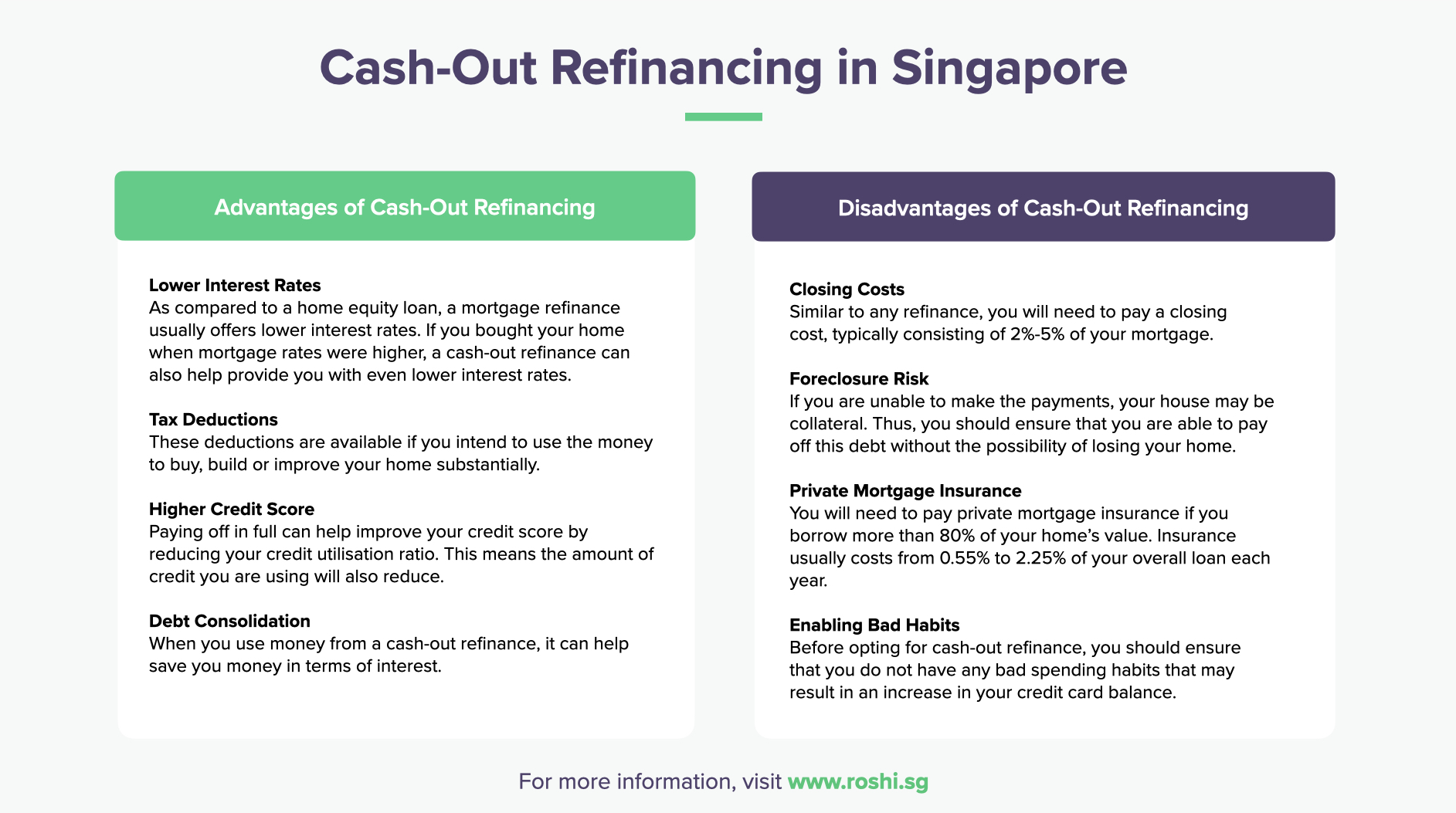
Cash-Out Refinancing for Private Properties

How to access home equity without selling the property.
Why Consider Switching?
The HDB concessionary loan rate is fixed at 2.6% p.a. (pegged to CPF OA rate + 0.1%). As of 2026 bank loan rates have fallen significantly below this level starting from 1.50% p.a.
Potential savings
Savings Icon 1% rate difference on $400k = $3,600/yr savings
Savings Icon Over 10 years, this exceeds $36,000 in savings
Banks are reporting significant increases in HDB owners switching from HDB loans to bank loans; some banks have seen a 7x increase in such applications.
Warning Icon This decision is irreversible
Once an HDB loan is refinanced to a bank loan it is not possible to switch back to an HDB loan.
What Is Cash-Out Refinancing?
Cash-out refinancing allows private property owners to borrow against the equity in their property. When refinancing, borrowers can withdraw cash up to the maximum LTV limit (75%), minus the outstanding loan and CPF monies used for the property.
Example: Property value $1,500,000
Maximum loan (75% LTV)
$1,125,000
-
Outstanding loan
$600,000
-
CPF used
$200,000
=
Cash available
$325,000
If outstanding HDB loan > $375,000, cash/CPF top-up may be needed
info icon Some banks may be flexible depending on current property valuation. Check with individual banks.
Why Common Uses for Cash-Out Funds
  • ▸ Property investment (down payment for second property)
  • ▸ Business investment or startup capital
  • ▸ Debt consolidation (pay off high-interest debts)
  • ▸ Children's education
  • ▸ Renovation or upgrading
  • ▸ Investment portfolio diversification
Info Icon Important Considerations
Maximum LTV
75% of property value
Interest Rate
Same as refinancing rates
CPF Withdrawal Rule
CPF used + accrued interest must be deducted
TDSR Applies
Total debt including new loan must be below 55% of income
Lock-In Period
Typically 2 to 3 years
Property Type
Private property only

True Cost of Refinancing

Understanding all fees involved and how to minimise them.
Why Cost Comparison: Refinancing vs Repricing
Cost ItemRefinancingRepricing
Legal fees$1,800 to $2,500Not required
Valuation fee$300 to $600Not required
Administrative fee$0 to $500$500 to $1,000
Total Costs$2,100 to $3,600$500 to $1,000
Legal subsidy from new bank$2,000 to $2,800Not applicable
Net Cost After Subsidy$0 to $1,000$500 to $1,000
Info Icon Important Considerations
If the current bank provided subsidies (legal, valuation, cashback) within the past 2-3 years, there may be clawback clauses requiring repayment of those subsidies upon refinancing.
  • ▸ Refinancing within 3 years of receiving subsidies: Full repayment
  • ▸ Refinancing within 2 years: Partial repayment
  • ▸ Check current loan agreement for specific terms
Info Icon Lock-In Penalty
If refinancing before the lock-in period ends, a penalty of approximately 1.5% of the outstanding loan amount typically applies.
Example:
Outstanding loan
$500,000
Lock-in penalty (1.5%)
$7,500
icon The penalty almost always exceeds potential interest savings. Wait for lock-in to end before refinancing.
Break-Even Calculation
How long to recover refinancing costs through interest savings?
Outstanding loan
$500,000
Current rate
3.0%
New rate
2.0%
Annual savings
$5,000
Net refinancing cost
$500 after subsidy
Break-even
1.2 months
For most borrowers with loans above $300,000, refinancing breaks even within the first year and then generates significant savings for the remainder of the lock-in period.

TDSR Rules for Refinancing

Understanding when TDSR applies and when exemptions are available.
General Rule
TDSR (Total Debt Servicing Ratio) limits total monthly debt payments to 55% of gross monthly income. This applies to property loans from banks.
Info Icon TDSR Exemptions for Refinancing
Good news:
TDSR does not apply to most refinancing scenarios. MAS provides exemptions to help homeowners refinance existing loans.
Property Type Owner-Occupied Investment
Refinancing (same or lower loan amount)ExemptExempt
Refinancing with cash-outAppliesApplies
Repricing (same bank)ExemptExempt
icon The penalty almost always exceeds potential interest savings. Wait for lock-in to end before refinancing.
icon Refinancing an investment property without committing to debt reduction
icon Increasing the loan amount through cash-out refinancing
icon Taking a new loan not refinancing an existing one
What If TDSR Is Not Met?
For investment properties, you can commit to a Debt Reduction Plan: agreeing to pay down at least 3% of the outstanding loan over 3 years .
3%
OVER 3 YEARS

How to Refinance (Step-by-Step Guide)

4 to 6 Months Before
Check Lock-In End Date
Review current loan documents to confirm when lock-in period ends. Refinancing should be initiated 4 to 6 months before lock-in ends to allow for processing time.
step-icon
4 Months Before
Compare Rates and Get Quotes
Use ROSHI to compare refinancing rates from 15+ banks. Request In-Principle Approval (IPA) from 2 to 3 banks to confirm eligibility and rates offered.
step-icon
3 to 4 Months Before
Choose Bank and Submit Application
Select the best package and submit a full refinancing application with all required documents. The new bank will process the application and arrange property valuation.
step-icon
3 Months Before
Serve Notice to Existing Bank
Once the new bank issues approval, serve notice to the existing bank typically 2 to 3 months notice required. The new bank's lawyers will handle communications.
step-icon
2 to 4 Weeks Before
Legal Work and Documentation
Visit the appointed law firm to sign refinancing documents. Lawyers handle the discharge of existing mortgage and registration of new mortgage.
step-icon
Day 0
Loan Transfer Complete
New loan is disbursed to pay off old loan. New mortgage terms take effect. Begin repayments to new bank.
step-icon
TOTAL TIMELINE
3 to 4 months
New loan is disbursed to pay off old loan. New mortgage terms take effect. Begin repayments to new bank.
Our Expert says

Our Mortgage Expert's Tips for 2026

With rates at multi-year lows and SORA around 1.1% to 1.2%, 2026 is an excellent time to refinance. Here's practical advice for different situations:

For HDB owners on bank loans: The promotional rate from 2-3 years ago has likely expired. Compare rates now, a 0.5% to 1% reduction is common and translates to significant savings.

For HDB owners on HDB loans (2.6%) : Bank rates are now well below 2.6%. The decision to switch is significant because it's irreversible. Calculate savings, consider rate fluctuation risks and decide based on personal risk tolerance.

For private property owners: Beyond rate shopping, consider whether cash out refinancing makes sense for investment or debt consolidation goals. Ensure any additional borrowing is within comfortable repayment capacity.

Rate tip: Don't just look at Year 1 rates. Check the spread after lock-in (Year 3+). A package with a lower Year 3 spread gives more buffer before the next refinance cycle.

Timing tip: Don't wait until the last minute. Start comparing 4 to 6 months before lock-in ends. Banks need 2 to 3 months to process and there's often a "lag cost" of paying the higher rate while waiting for the switch.

Rate tip: Don't just look at Year 1 rates. Check the spread after lock-in (Year 3+). A package with a lower Year 3 spread gives more buffer before the next refinance cycle. Quote Icon

Trinh Thanh
Trinh Thanh
Head of Research
img

8-Point Refinancing Checklist

check-icon
Confirm lock-in period end date
Check loan documents or call your current bank. Never refinance while in lock-in unless absolutely necessary.
check-icon
Calculate potential savings
Use a refinancing calculator to estimate monthly and total savings based on current vs new rates.
check-icon
Check for clawback clauses
If the current bank provided subsidies in the past 2 to 3 years, check if they must be repaid upon refinancing.
check-icon
Compare rates from multiple banks
Don't settle for the first offer, compare at least 3-5 banks to find the best rate and features.
check-icon
Review the spread after lock-in
Year 1 rate matters but Year 3+ spread is what borrowers will pay until the next refinance.
check-icon
Factor in all costs
Legal fees, valuation and admin fees vs subsidies and cashback.
check-icon
Prepare documents early
Gather payslips, CPF statements, NOA and current loan statements before applying.
check-icon
Allow sufficient time
Start the process 4 to 6 months before lock-in ends. Refinancing takes 3 to 4 months to complete.

How Much Could Refinancing Save?

Based on switching from 3.0% to 1.75%
Outstanding LoanMonthly SavingsAnnual Savings3-Year Savings
$200,000$130$1,560$4,680
$400,000$260$3,120$9,360
$600,000$390$4,680$14,040
$800,000$520$6,240$18,720
$1,000,000$650$7,800$23,400
Icon The penalty almost always exceeds potential interest savings. Wait for lock-in to end before refinancing.

Is Refinancing Right for My Situation?

switch icon
Consider Switching if:
  • ▸ Lock-in period has ended or is ending soon
  • ▸ Current rate is significantly higher (0.5%+ difference)
  • ▸ Outstanding loan is above $300,000
  • ▸ Planning to stay in property for at least 3 more years
  • ▸ Wanting to switch from floating to fixed
  • ▸ Current bank's repricing rates are not competitive
  • ▸ Wanting features current bank doesn't offer
switch icon
When Refinancing May Not Make Sense:
  • ▸ Still within lock-in period (1.5% penalty applies)
  • ▸ Outstanding loan is below $100,000 many banks don't refinance small loans
  • ▸ Planning to sell property within 1 to 2 years
  • ▸ Rate difference is minimal
  • ▸ Current bank offers competitive repricing rates
  • ▸ Unable to meet bank's credit requirements

6 Common Refinancing Mistakes to Avoid

Mistake Icon
Waiting until lock-in has already ended
This results in paying the higher "revert rate" for months while waiting for the new loan to process. Start 4-6 months early.
Mistake Icon
Only comparing interest rates
Look beyond the headline rate. Check lock-in period, spread after lock-in, legal subsidy, features and total cost of the package.
Mistake Icon
Forgetting about clawback clauses
If subsidies were received from the current bank, check if they must be repaid. Factor this into the savings calculation.
Mistake Icon
Not checking all cost
Legal fees, valuation, admin fees and any cancellation charges. Most are subsidised but confirm the net cost.
Mistake Icon
Ignoring the spread after lock-in
A package with 1.5% Year 1 but SORA+1.5% Year 3 may cost more over time than 1.6% Year 1 with SORA+0.5% Year 3.
Mistake Icon
Not serving notice on time
Most banks require 2 to 3 months notice before the loan can be transferred. Late notice means extra months at the old rate.

How to Find The Right Refinance Loan (FAQs)

What is home loan refinancing?

Refinancing is switching an existing home loan from one bank to a different bank, typically to secure a lower interest rate or better loan features. The new bank pays off the old loan and issues a new mortgage.
Refinancing means switching banks entirely, while repricing means switching to a different loan package within the same bank. Refinancing typically offers lower rates but takes longer and involves legal fees. Repricing is faster and simpler but may have slightly higher rates.
Start comparing rates 4-6 months before lock-in ends. The process takes 3-4 months, so early preparation avoids paying the higher "revert rate" while waiting.
If refinancing within the lock-in period, a penalty of approximately 1.5% of the outstanding loan applies. After lock-in ends, there is no penalty for refinancing.
  • - Legal fees ($1,800-$2,500)
  • - Valuation ($300-$600)
  • - Admin fees ($0-$500)
Most banks offer legal subsidies of $2,000-$2,800, often covering most or all costs.
Yes, you can refinance an HDB loan to a bank loan. However, once switched to a bank loan, it is not possible to switch back to an HDB loan. The current HDB rate (2.6%) is higher than most bank rates, so switching can save money.
For owner-occupied property refinancing (same or lower loan amount), TDSR is exempt. For investment property, TDSR applies unless committing to a 3% debt reduction plan.
Cash-out refinancing allows private property owners to borrow against home equity up to 75% of property value minus outstanding loan and CPF used. The withdrawn cash can be used for any purpose.
NRIC, latest 3 months payslips, 12 months CPF contribution, latest NOA, current loan statement and property documents. Self-employed: 2 years NOA and financial statements.
The entire process takes 3 to 4 months: application and approval (2-4 weeks), notice period to existing bank (2-3 months) and legal completion (2-4 weeks).
Most banks require a minimum outstanding loan of $100,000 for refinancing. For loans below $300,000, repricing may be more cost effective.
Fixed rates offer stability (1.50%-1.80% for 2-3 years). Floating rates (SORA+0.25% to 0.50%) are currently slightly lower but can fluctuate. Choose based on risk tolerance and interest rate outlook.
After the promotional fixed rate period ends, the loan reverts to a floating rate calculated as SORA + spread. A lower spread (e.g., SORA+0.50% vs SORA+1.00%) means lower rates after lock-in.
Possibly, but the new LTV calculation will be based on current valuation. If the property value has fallen significantly, the new bank may offer a smaller loan, requiring cash top-up.
Most homeowners refinance every 2-3 years when their lock-in period ends. Each refinance is an opportunity to secure competitive rates and avoid paying the higher revert rate.

Our customers trust us when it comes to making important borrowing decisions

Google Logo Aya Medel
Star Star Star Star Star
a month ago

I used ROSHI platform to find the best loan offers. Just need to fill up some details and wait for loan offers and can choose which one you like. It is totally free and can receive vouchers and cashback based on the loan amount approved. Thank you ROSHI

Google Logo Everlean
Star Star Star Star Star
5 months ago

I can’t thank Roshi enough for helping me find the best financial institution for my DCP! The guidance and support were absolutely amazing—everything was explained clearly and tailored to my needs. Thanks to Roshi’s help, I’m now on track and completely debt-free in just 12 months! 💪🏼 I couldn’t be happier with the outcome and highly recommend Roshi to anyone looking for smart, reliable financial advice.

Google Logo Mohamed Faizal Jaafar
Star Star Star Star Star
5 months ago

With the help of the ROSHI Support link to partner, I had a great experience with EZY Loan. The online application was simple, document verification was fast, and the funds were credited on the same day. The staff were professional and explained everything clearly, with no hidden fees. Overall, an excellent and hassle-free service!

Google Logo Sabby Debbie
Star Star Star Star Star
5 months ago

Roshi service will update all your listings to match your nearest requested amount accurately, saving you time and effort by eliminating the need to visit each location individually. Recommended !
Explore Our Range of
Relevant Expert Guides

Explore Other Financing Options

Refinancing is not the only way to optimise a mortgage. For homeowners looking to access cash from their property's value without selling, home equity loans offer a way to unlock funds for personal or business investment needs. Home buyers purchasing a new property can compare home loan rates from 15+ banks .

For quick estimates on potential savings when switching to a lower rate, our refinance calculator compares current repayments against new rates and factors in costs to determine if refinancing makes financial sense.

For bank specific refinancing packages and features, reviews are available for local banks including DBS, OCBC and Maybank as well as foreign banks such as Standard Chartered, HSBC, Citibank and Bank of China.